 Skip to main content




Hiring in New Zealand: 2027 EOR Guide for Australian Companies

Key takeaways
- New Zealand holds about $154.7 billion USD of Australian capital, 4.9% of everything Australia has invested abroad and the third-largest share after the US and the UK.
- In New Zealand, an employment agreement must be in writing, and a 90-day trial period only protects the employer if it was agreed and signed before the employee’s first day.
- Employers must contribute at least 3.5% of gross pay to KiwiSaver from 1 April 2026, and new employees are enrolled automatically.
- Safeguard Global, a gold winner at the 2025 HRM Asia Readers’ Choice Awards, runs New Zealand hires for Australian clients through an Australia-based team.
When you’re an Australia-based company, New Zealand is the expansion that rarely gets a board paper. It is close, the time difference is small, the accent is familiar, and many Australian companies already sell there. Hiring your first person in Auckland or Wellington can feel like opening another state office.
But feelings can be deceiving. New Zealand is its own country, with its own employment statute, retirement scheme, and tax authority. It has a dispute system that is quick for employees to use. The simplest way to see where the differences sit is to follow one hire from the offer to the first year. But first, let’s take a look at how Australian businesses are investing in New Zealand.
Why do so many Australian companies start in New Zealand?
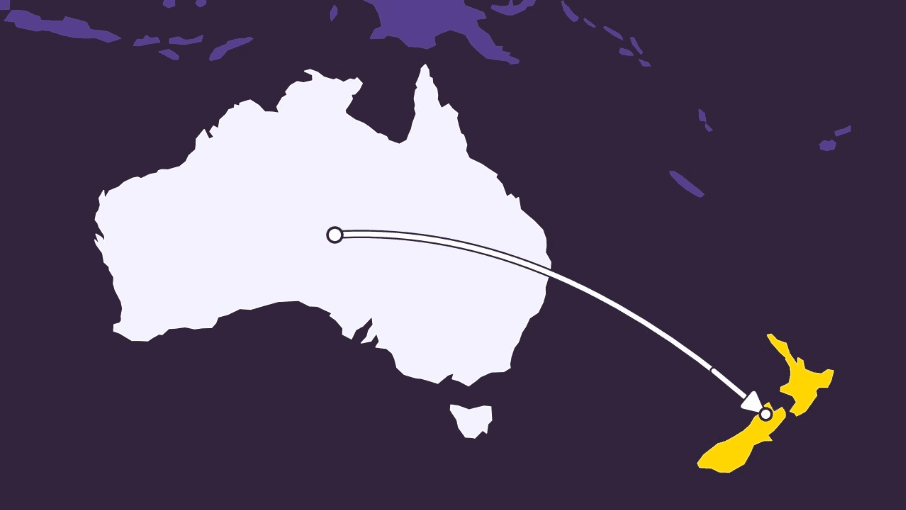
At the end of 2025, [Australian capital held overseas](https://www.abs.gov.au/statistics/economy/international-trade/international-investment-position-australia-supplementary-statistics/latest-release) came to $3,125.5 billion USD, and about $154.7 billion USD of it was in New Zealand. That is 4.9% of the total, behind only the US and the UK, and the New Zealand figure grew 8.0% over the year (figures from the Australian Bureau of Statistics, converted at October 2026 rates).
In other words, companies are already investing in New Zealand. Understanding your options for how to employ there in full compliance isn’t something you should improvise.
The offer: What must be in writing in New Zealand?
Under the Employment Relations Act 2000, every employee needs a written employment agreement. Before it is signed, the employer must tell the candidate they are entitled to seek independent advice and give them a reasonable opportunity to do so.
The agreement also has to set the notice period. New Zealand has no statutory minimum notice for ordinary employees, so the figure is whatever the parties agree. For an Australian company accustomed to the National Employment Standards filling that gap, this is the first surprise about employing in New Zealand: if the agreement doesn’t specify, there is no default to fall back on, and a court will decide what was reasonable.
Every party is also bound by a duty of good faith, which is broader than most Australians expect. It covers being responsive and communicative, and it applies during the employment relationship, not only at its end.
Before day one: The trial period
New Zealand allows a 90-day trial period, and since December 2023, it has been available to employers of any size. During the trial, an employer can end the employment without the employee being able to bring a personal grievance for unjustified dismissal.
The conditions are strict. The trial clause must be in the written agreement and signed before the employee starts work. It cannot be used for someone the employer has employed before. And it only removes the unjustified dismissal claim; the employee can still raise other grievances, such as discrimination or unjustified disadvantage. A trial clause signed on the first morning is generally treated as invalid, which leaves the employer with an ordinary permanent employee from day one.
Day one: Tax and KiwiSaver
On day one, your new hire from New Zealand completes a tax code declaration so the right PAYE (tax) deductions apply. Most new employees aged 18 to 65 are also enrolled in KiwiSaver automatically and can opt out between their second and eighth week. KiwiSaver is similar to Australia’s super in purpose, but functions much differently. It’s voluntary, paid into by both employers and employees, and can be used to purchase a home in addition to retirement savings.
The employer’s side is where Australian companies often miscalculate. From 1 April 2026, the minimum employer contribution is 3.5% of gross pay, and it is scheduled to rise again in 2028. Employer contributions also attract employer superannuation contribution tax, deducted before the money reaches the employee’s account, so the gross cost and the amount the employee sees are not the same number.
The first payday
When wages are paid in New Zealand, PAYE is withheld, and the employer reports the pay run to Inland Revenue under payday filing, generally within two working days of payday. KiwiSaver deductions and employer contributions follow the same rules.
Accident Compensation Corporation levies sit on top. New Zealand’s no-fault accident scheme replaces most personal injury claims against employers, and the cost is recovered through levies on employers and earnings. Unlike Australian workers compensation, it’s priced and administered nationally rather than by state.

Month six and month twelve
After 6 months of continuous employment, employees in New Zealand are entitled to 10 days of paid sick leave a year. After 12 months, they become entitled to 4 weeks of paid annual holidays. Public holidays, including Matariki, apply in between, and the rules on what a worked public holiday costs are detailed enough to catch out a payroll run that was set up by hand.
The Holidays Act 2003 has a long record of payroll errors across New Zealand employers, many of them large and well-advised. You need a payroll or EOR provider who has experience paying and supporting employees in New Zealand.
And if it doesn't work out?
An employee in New Zealand who believes they were unjustifiably dismissed or disadvantaged has 90 days to raise a personal grievance. The test is what a fair and reasonable employer could have done in the circumstances. How the decision was reached matters just as much as the reason for it. Process failures alone can make a dismissal unjustified in the eyes of a New Zealand court.
This is the moment the earlier steps pay off (or fall apart): a valid trial clause, a clear notice period, and a documented process will decide the outcome.

How Safeguard Global handles a New Zealand hire
When Australian companies use Safeguard Global as their EOR, we become the legal employer, while your team directs the work. That means we issue an employment agreement that meets New Zealand’s statutory requirements as well as your own, run PAYE and payday filing, administer KiwiSaver and ACC, and calculate leave under the Holidays Act. The employee works with your team directly, and you direct their day-to-day work.
For our Australian clients hiring in New Zealand, that arrangement is run by an Australia-based team that works in your hours and understands where the two systems differ. We’re here to answer any questions you have, advise you on best practices and cultural nuances, and support your New Zealand workers themselves. More than 1,500 organisations currently rely on Safeguard Global for international workforce enablement, and the region’s HR practitioners made us their gold choice for Best Employer of Record Service Provider in the 2025 HRM Asia Readers’ Choice Awards.
EOR pricing starts from $499 USD per employee each month, which annualises to just under $6,000 USD, often less than a single holiday pay correction. To compare a role in Auckland against the same role in Sydney before deciding where to hire, Intelligent Workforce sets live salary benchmarks against employer costs at no charge.
In summary
Before you send an offer to a New Zealand employee, check three things:
- The agreement states a notice period.
- The trial clause, if you want one, will be signed before day one.
- Someone from your team owns the holiday pay calculation from the first payday, not the first complaint.
With Safeguard Global as your EOR, all three are settled before the employee starts.
Frequently asked questions (FAQs)



Talk to Sales
Book a demo today
We’d love to learn more about your needs and show you how we can help. Submit the form and we’ll be in touch to schedule a personalized demonstration of our platform and services.
Schedule an appointment
Fill out the form to speak to a rep about how we can help your organization.
