 Skip to main content





Online research
Global hiring shouldn’t cost you $1M in losses.
Yet 22% of CFOs say it has.
We surveyed 400 CFOs in the US and UK about global hiring. They told us they're prepared — their hiring activity tells a different story.
TRUSTED BY 1,500+ GLOBAL ORGANIZATIONS

















Confidence is strong. So why isn't the hiring?
Global hiring decisions sit firmly in the CFO's remit. The approval, the budget, the risk exposure, the compliance liability — finance leaders own all of it. And by every measure of self-assessment, they feel ready. Nearly every CFO we surveyed described their organization as interested, investing, or actively scaling its global workforce.
But confidence and execution are two different things. When we looked beyond what CFOs said about their readiness and into what their organizations are doing — and what it has cost them — a more complicated picture emerged.
That gap — between how prepared CFOs say they are to hire globally, and the complex realities they face — is what this report is about. We're calling it the CFO Confidence Paradox, and understanding it is the first step toward closing it.

Interest is near-universal
97% of CFOs say their organization is interested, investing, or actively engaged in global hiring.
CFOs from both the UK and US report that their organization is interested, if not actively engaged, in global hiring. Slightly more US CFOs than UK CFOs say their company is well structured and actively scaling their global workforce. But it’s clear that both groups see global hiring as critical for their company’s competitiveness.
CFOs say their organizations are
- 47%
- Confident, well-structured, and actively scaling their global workforce
- 35%
- Investing in global hiring but still refining their processes and approach
- 15%
- Interested in global hiring but face challenges around cost, risk, or complexity
- 3%
- Only pursue global hiring when necessary or avoid it outright
But the hiring isn’t following
Only 22% have plans to hire globally in the next six months.
This is where the paradox becomes visible. CFOs report that their organization is interested in global hiring. Only 3% said otherwise. Furthermore, 96% of CFOs said their company is prepared to hire globally. But if they’re interested and prepared, why are 37% decreasing global hiring, prioritizing domestic hiring over international hiring, or both? Why aren’t more than 22% planning to hire overseas in the next six months?
Restraint in hiring reported by CFOs
- 37%
- of CFOs said their organization is prioritizing domestic hiring over international hiring, planning to decrease cross-border hiring, or both.
- 22%
- of CFOs, a surprisingly low figure, said their organization has plans to hire globally in the next six months.
Hiring plans
How many companies plan to hire globally in the next six months?
22% of the 400 CFOs surveyed said their organization has plans to hire globally in the next six months. US CFOs were slightly ahead of their UK counterparts, at 24% against 20%.
Set against that, 37% said their organization is prioritizing domestic hiring over international hiring, planning to decrease cross-border hiring, or both. Broken out by country, 21% of UK CFOs are prioritizing domestic hiring in the next year against 15% in the US, and 23% of UK CFOs expect to decrease global hiring against 16% in the US.
That is the gap the report calls the paradox. Interest sits at 97% and preparedness at 96%, while firm six-month plans sit at 22%.
And the cost of getting it wrong is real
Every company we surveyed has suffered losses from noncompliance.
The report highlights causes for the restraint in global hiring that CFOs report, including operational challenges, geopolitical disruption, and financial losses caused by noncompliance.
Download the report to find out what CFOs said about each of these factors as well as how significant their compliance-related losses were.
Reported losses from noncompliance
CFOs reported losses of up to $1M USD
- 86%
- 70%
- 78%
CFOs reported losses of $1M USD or more
- 14%
- 30%
- 22%
Why this matters for finance leaders
For CFOs, global hiring is a cost and risk decision before it's a talent one. But confidence without visibility is exposure. Without a clear view of country-level spend, compliance obligations, and currency and payroll complexity, the savings that CFOs achieved can be washed away. This report gives you the numbers to pressure-test your own assumptions, benchmark against 400 peers, and build a board-ready view of where global workforce risk really sits.

Geopolitical risk
How has geopolitical disruption affected global hiring?
40% of CFOs said geopolitical disruption has made their organization more cautious about hiring globally, and 38% said it has hindered their company's ability to expand. 19% have relocated an existing employee to another country because of geopolitical conflict in the past 12 months.
Organizations responded in different ways, and the sharpest difference between the two countries is in where they hire. 44% of UK CFOs shifted hiring to lower-risk, more stable markets, against 31% in the US.
Other responses were closer. Delayed or reduced hiring in affected regions ran at 38% in the UK and 35% in the US, increased contingency or buffer budgets at 38% and 34%, increased relocation or mobility budget at 36% and 40%, and reallocated budget to different regions at 33% and 29%.
Inside the report
The CFO Confidence Paradox report draws on survey responses from 400 finance leaders across the US and UK to examine how organizations are approaching global hiring, where confidence is holding up under scrutiny, and where the gaps between stated readiness and actual outcomes are widest. Here's what you'll find inside:

The confidence CFOs report and where it's justified

The restraint beneath it: What CFOs are actually planning to do

The real risks of global hiring: Compliance, geopolitical disruption, and operational

The US vs UK risk gap: Two markets, two very different risk profiles

How to close the gap between confidence and restraint
What would help
What would help CFOs hire globally with more confidence?
Asked what would improve their ability to handle the complexities of global hiring, CFOs named three things above all others: help with local contracts, payroll or benefits; clear, country-specific compliance guidance; and faster onboarding timelines.
All three describe the same underlying problem. Global hiring requires an organization to rebuild its processes country by country and to keep track of employment law that changes constantly, so the constraint is rarely willingness and usually local infrastructure.

"The challenges CFOs face in managing global hiring — from both inside and outside their organizations — are only becoming more complex. While they're confident in their ability to manage cross-border hiring and capitalize on global opportunities, many may underestimate the resources needed to navigate the realities of international employment. That's the CFO confidence paradox in a nutshell: confidence is high, but execution remains difficult. To bridge the gap, CFOs need more than confidence — they need the right support to simplify compliance, reduce risk, and scale global hiring with certainty."

Florence Cazemajou-Flint
Chief Financial Officer, Safeguard Global
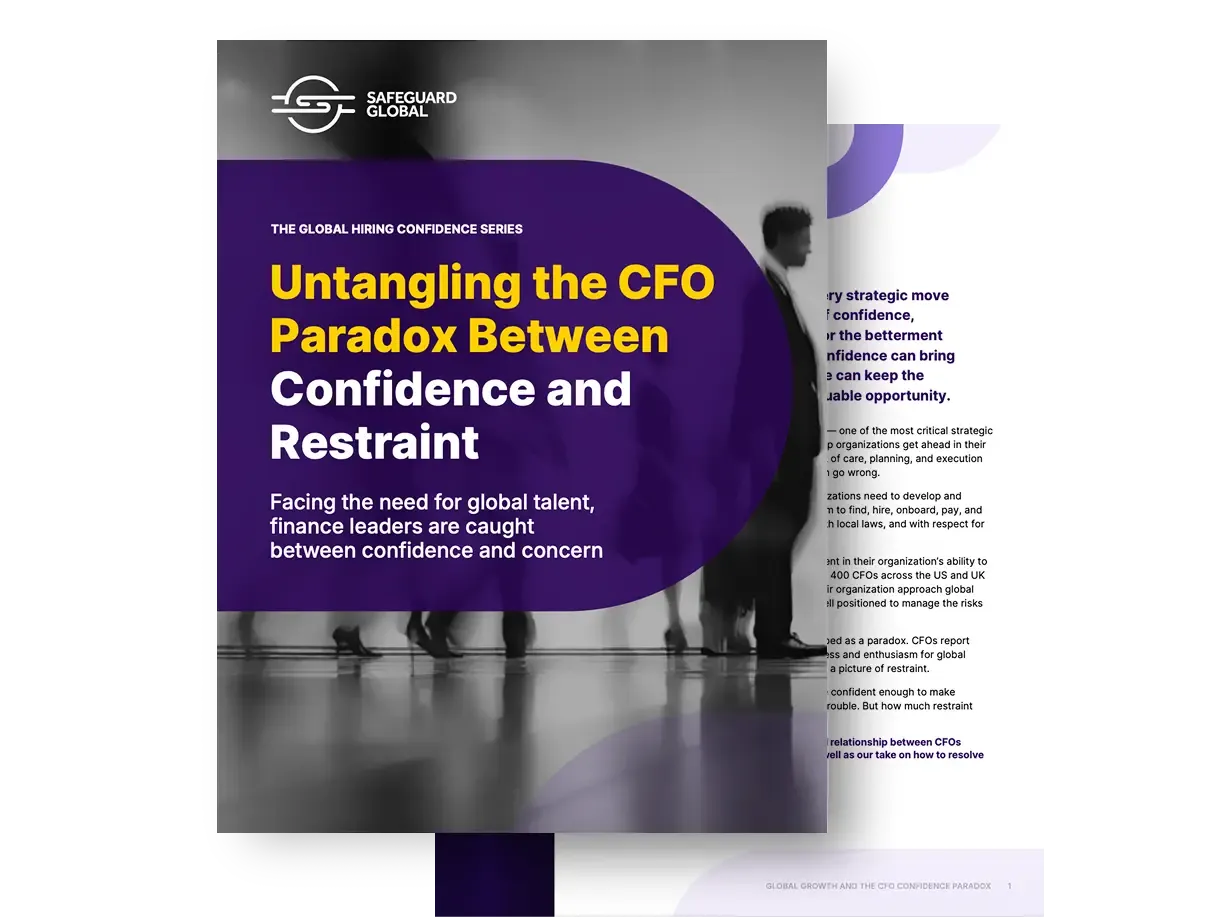
Get the 2026 CFO Confidence Paradox report
See the full data behind the paradox and what it means for your global workforce plans.
Get the report
Fill out the form and the download will start as soon as you submit.
Get the 2026 CFO Confidence Paradox report
See the full data behind the paradox and what it means for your global workforce plans.
Thank you for downloading the ebook!

FAQs