




Hiring in the US: 2026 EOR Guide for Australian Companies


Key takeaways
- The United States holds roughly $1,170 billion USD, about 36.6% of everything Australia has invested abroad, more than any other destination.
- Employment is regulated state by state as well as federally, there is no statutory severance, and at-will employment sits beneath a dense layer of anti-discrimination and anti-retaliation laws.
- Misclassification, wrongful termination, and permanent establishment are the three exposures that decide how an Australian company should structure its first US hires.
- Safeguard Global employs workers through its own American entity, pairs an Australia-based team with in-country specialists, and was voted gold for Best Employer of Record Service Provider at the 2025 HRM Asia Readers’ Choice Awards.
Ask an Australian founder where the business goes next and America comes up before anywhere else. The customers are there, the capital is there, and a credible US presence often decides whether a company stays a strong local operator or becomes something larger. None of that is in dispute. What trips people up is the assumption that a shared language means a shared employment system.
Australia already bets more on America than on any other country
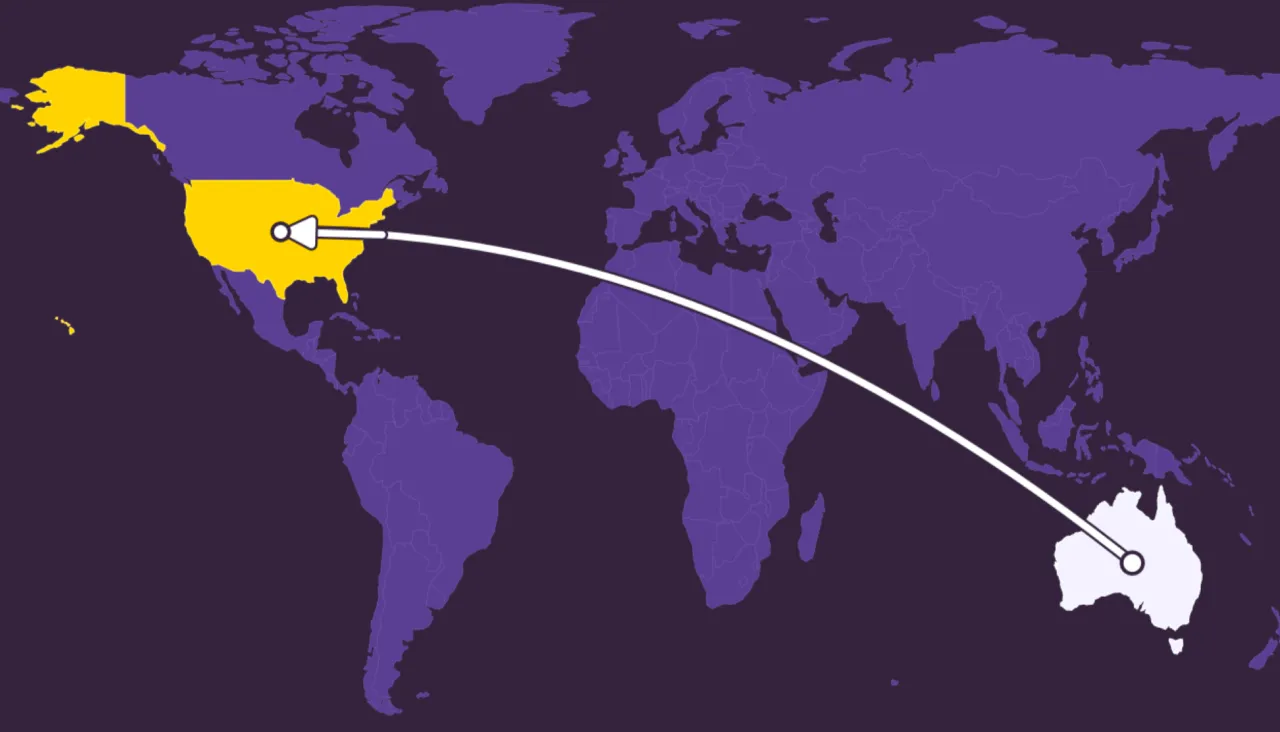
The numbers explain why so many boards treat this as inevitable rather than optional. At the end of 2025, Australian capital held overseas came to roughly $3,200 billion USD, and the United States accounted for about $1,169 billion USD of it, or 36.5% of everything Australia has placed abroad. Nothing else is close. The flow also runs harder outward than most people assume. American investment in Australia sat at around $973 billion USD over the same period, less than Australia holds in the US. In net terms, Australia is the more committed partner.
For an operating business rather than a fund, those figures describe a market where the bankers, lawyers, and customers are already used to Australian companies. The commercial path is well worn. The employment machinery underneath it is not.
What a mistake actually costs
It is worth starting with the downside, because the American cost of error is unusual and it should shape the structure you choose rather than be discovered afterwards.
Misclassification is the common one. Engage your first American as a contractor, direct their hours, give them your systems, and a regulator looking at the substance of the arrangement rather than its label can reclassify the relationship. Back taxes, unpaid benefits, and penalties follow, and they surface during due diligence or a falling out rather than at a convenient moment.
Wrongful termination is the second. Most states operate at-will employment, which sounds permissive until you meet the body of federal and state rules on discrimination and retaliation sitting beneath it. Those rules are where claims originate, and defending yourself against such a claim costs real money, whatever the outcome.
Permanent establishment is the third. Activity that starts to resemble a settled business presence can persuade a tax authority that your Australian company owes corporate tax in the United States, not merely payroll tax on a salary.
Fifty rulebooks behind one flag
Australia hands you a single national framework. The Fair Work Act sets the floor, Modern Awards fill in the industry detail, and superannuation behaves identically in Perth and Brisbane.
America has nothing equivalent. Federal statutes such as the Fair Labor Standards Act, the Family and Medical Leave Act, and the Occupational Safety and Health Act form one layer, and state regulation sits on top of it. The standard week runs to 40 hours across five days, there is no federal cap on daily hours though some states impose one, and rest breaks are set locally rather than nationally. Payroll taxes, unemployment insurance, workers compensation, and the rules on final pay all change as you cross a state line. Getting a hire right in New York teaches you very little about Texas.
Two further points catch Australians out. There is no statutory severance in the United States, so anything of that kind comes from the contract or company policy, which puts far more weight on what you write down than you are used to at home. And American law limits how staffing agencies may supply workers, permitting it only for genuinely temporary or occasional tasks, which rules out running an indefinite arrangement through an agency.
Both shortcuts are closed
That leaves the two instinctive routes looking weak. Registering your own American entity and standing up payroll in each relevant state is slow, costly, and out of all proportion to a first hire or two. Engaging contractors runs directly at the risk described above.
An employer of record occupies the space between them. The provider already holds a US entity and becomes the employer on paper, issuing a contract that satisfies the relevant state, running payroll, withholding and remitting federal and state taxes, and administering benefits, while your team directs the work. Someone is productive in America within weeks rather than months, and you learn whether the market deserves a permanent commitment before making one.
What Safeguard Global does that others do not
The first thing to establish about any provider is whether it owns its American entity or quietly subcontracts the employment to a local agency. Many operate as aggregators, and in a litigious market that additional link is precisely what you do not want when a dispute lands. Safeguard Global holds entities of its own in the markets that count, the United States among them, so one organisation stays answerable rather than a chain of them.
For Australian businesses the arrangement is run by an Australia-based team working in your hours and reading your commercial context, with in-country specialists positioned where the employee actually sits. How that splits responsibility between you, the worker, and the employer of record is set out on the Safeguard Global Employer of Record page for Australian companies.
Then there is the question of who picks up the phone when something turns complicated. More than 400 specialists based in the countries they cover stand behind the entity, which is what matters when you are structuring equity for a New York executive, deciding which state governs a remote hire, or closing an employment cleanly. The slickest platforms onboard beautifully and hand the consequential decisions straight back to you, at the exact point the legal weight is greatest. In 2025, Safeguard Global was voted gold for Best Employer of Record Service Provider at the HRM Asia Readers’ Choice Awards, a result decided by the region’s HR community rather than by a marketing department.

Pricing you can put in a budget
Model the true cost before you choose a state, because a salary figure tells you almost nothing in a country where payroll taxes and insurance obligations shift so sharply across borders. Intelligent Workforce from Safeguard Global is free to use and does exactly that, setting live salary benchmarks against employer costs and benefits expectations, so a Texas role can be held against the same job in New York or California, or against keeping it in Australia.
The service itself runs from $499 USD to $800 USD per employee each month, depending on the state and the level of support, with a setup charge and a twelve-month term alongside. Cheaper names undercut that comfortably, generally by working through borrowed local firms with thin experience of American complications. Set the savings against the three exposures described earlier, any one of which can cost several times a year of fees
Before you make the first offer
Three things are worth settling while it is still cheap to change your mind. Decide which state the role genuinely sits in, because that choice governs almost everything that follows. Write the contract as though there is no statutory safety net behind it, because there is not. And agree who inside your business owns the American employment relationship, since the failure mode is usually not a bad decision but an unowned one.
Handle those, let Safeguard Global carry the machinery, and the United States becomes what it looked like from Sydney in the first place: the largest opportunity available to an Australian company, and a manageable one.
Frequently asked questions (FAQs)
More Resources




Talk to Sales
Book a demo today
We’d love to learn more about your needs and show you how we can help. Submit the form and we’ll be in touch to schedule a personalized demonstration of our platform and services.
Schedule an appointment
Fill out the form to speak to a rep about how we can help your organization.