 Skip to main content




Hiring in the UK for Singaporean Companies: 2027 EOR and Compliance Guide


Key takeaways
- The UK holds about $85.6 billion USD of Singapore’s direct investment abroad, 6.6% of the total and the largest share of any destination outside Asia.
- From 1 January 2027, employees qualify for unfair dismissal protection after 6 months’ service instead of 2 years, and the cap on compensation is removed.
- Since April 2026, statutory sick pay has been payable from the first day of absence, and paternity leave has been a day-one right.
- Safeguard Global, with more than 400 in-country experts in the markets it covers and 18+ years in global employment, acts as an employer of record (EOR) to employ UK staff on behalf of Singaporean companies without a UK entity.
London is the natural European base for Singaporean firms in finance, technology, shipping, and professional services. The legal system is familiar, English law underpins many Singapore contracts, and the working culture translates easily.

Why is the UK such a large destination for Singaporean capital?
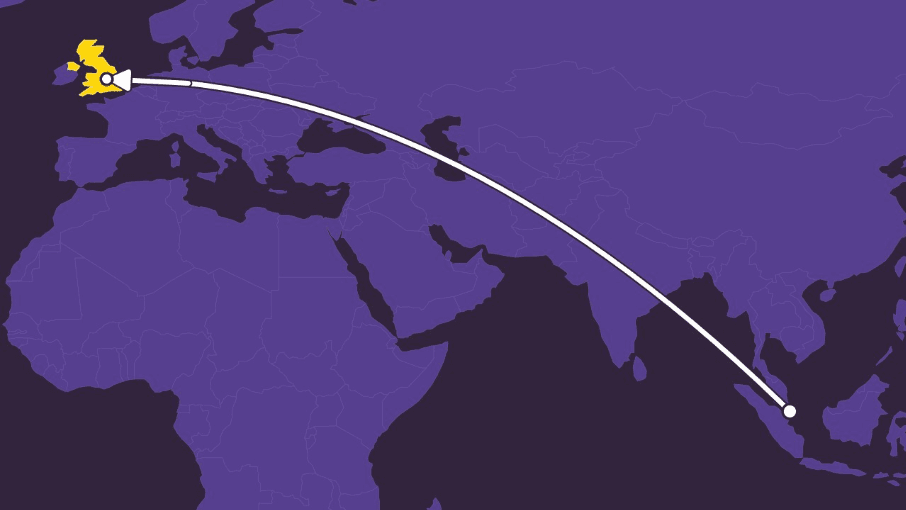
At the end of 2024, Singapore’s direct investment in the UK stood at about $85.6 billion USD, 6.6% of the $1,289.4 billion USD Singapore held abroad (Singapore Department of Statistics, converted at October 2026 rates). Only mainland China and India held more.
Before day one
When employing in the UK, there are two major items you must confirm before day one. The employer (or their EOR) must confirm the candidate’s right to work in the UK before they start (and must keep evidence of the check). Failing to do so can carry civil penalties and, for breaches committed knowingly, criminal liability.
The second item is worker classification. If the role is going to be filled by a contractor rather than an employee, the off-payroll working rules, known as IR35, decide whether tax and National Insurance should be treated as if they were employment income. For a Singaporean company used to a clearer line between employees and service providers, this is a frequent source of risk.
Day one
In the UK, the employee must receive a written statement of the main terms of employment on or before the first day. It covers pay, hours, holiday, notice, and other particulars set out in law.
Two Employment Rights Act changes took effect in April 2026 and now apply from the very start. Statutory sick pay is payable from the first day of sickness absence, with the former waiting days removed. Paternity leave and unpaid parental leave are available from day one of employment, rather than after a qualifying period. A new enforcement body, the Fair Work Agency, launched at the same time to oversee pay and leave rights.
Month one
The first payroll runs through Pay As You Earn (PAYE), the UK’s system that handles tax withholding and social contributions. Income tax and employee National Insurance are deducted and reported to HMRC in real time on or before each payday. The employer pays its own National Insurance contributions at 15% on earnings above the secondary threshold, a significant cost that Singaporean businesses expanding into the area sometimes forget to budget for.
Workplace pension auto-enrolment also starts here. Eligible employees must be enrolled in a qualifying pension scheme, with the employer contributing at least 3% of qualifying earnings and a minimum total of 8%. Employers can postpone enrolment for up to three months, but cannot avoid it. Unlike CPF, the obligation applies regardless of nationality.

Month six
After six months of employment, employees in the UK gain protection from unfair dismissal. This change, which takes effect from 1 January 2027, replaces the prior time period of two years.
The change is the most consequential one for overseas employers. Dismissing an employee after month six now needs a fair reason, such as conduct, capability, or redundancy, and a fair process, including a warning, an opportunity to respond, and a right of appeal. With the compensation cap removed, the financial exposure for getting it wrong is no longer bounded.
This means that it’s more important than ever before to treat the first six months as a genuine assessment period. If there are concerns, they should be raised, documented, and resolved before the threshold is reached.
Month twelve
By the end of the first year, the employee will have had their full statutory holiday entitlement, which for a full-time employee is 5.6 weeks (28 days) including bank holidays.
The exit
When employment ends, the employer must give at least the contractual or statutory notice, whichever is longer. Statutory noticein the UK is as follows.
- Less than one month of service: No notice required
- One month to less than two years: At least one week's notice
- Two years or more: One week for each complete year of continuous service, with a maximum of 12 weeks
Employers must also pay any untaken holidays, and, for redundancies of employees with two or more years’ service, pay statutory redundancy pay. Larger redundancy programmes trigger collective consultation duties.

How Safeguard Global manages a UK hire for a Singaporean company
As an EOR, Safeguard Global becomes the legal employer in the UK, carries out right-to-work checks, issues a compliant written statement of employment terms, runs PAYE and auto-enrolment, and advises managers on performance and process well before the six-month mark. Our 400+ in-country experts include UK specialists who have updated contracts and guidance for the Employment Rights Act changes, and with 18+ years in global employment, we’ve managed hires through several rounds of UK reform.
The entry price of $499 USD per employee a month for EOR comes to roughly $6,000 USD a year, far less than the cost of a single unfair dismissal claim under the new rules. To compare the full cost of a London role against Singapore or another European city, Intelligent Workforce sets live salary benchmarks against employer costs and benefits at no charge.
Frequently asked questions (FAQs)
More Resources




Talk to Sales
Book a demo today
We’d love to learn more about your needs and show you how we can help. Submit the form and we’ll be in touch to schedule a personalized demonstration of our platform and services.
Schedule an appointment
Fill out the form to speak to a rep about how we can help your organization.
