




Hiring in the UK: 2026 EOR Guide for Australian Companies


Key takeaways
- The United Kingdom is the second largest destination for Australian capital at about $448 billion USD, roughly 14.0% of the $3,200 billion USD Australia holds offshore. IR35, pension auto enrolment, and right-to-work checks are the three obligations that catch Australian employers, and none of them has a direct Australian equivalent.
- Unfair dismissal turns on the fairness of the process rather than the commercial merit of the decision; statutory notice runs from one week to 12; and four continuous years of fixed-term contracts can create permanent status.
- Through its Employer of Record solution, Safeguard Global employs workers through a UK entity it owns outright, plans the hire with an Australia-based team, and supports more than 1,500 organisations worldwide.
The UK is the most natural second market an Australian company ever considers. Shared language, common legal roots, a workable handover with Sydney, and London still functioning as the door into Europe. The familiarity is real. It is also the reason Australian employers arrive assuming they understand British employment law and then meet it properly for the first time in a tribunal.
Second only to America in Australian capital
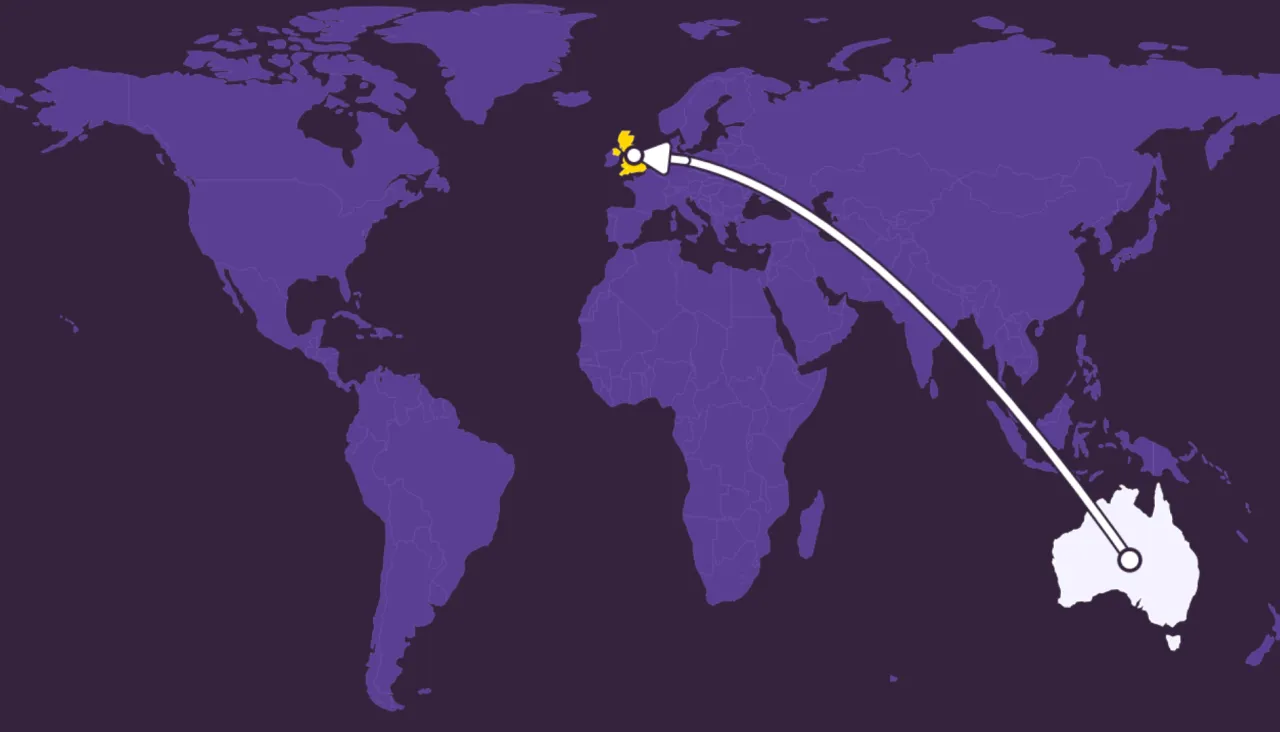
This is not a sentimental destination. At the end of 2025 Australian investment in the United Kingdom stood at roughly $448 billion USD, about 14.0% of the $3,200 billion USD Australia holds offshore. Only the United States ranks above it, and together the two absorb more than half of all Australian capital deployed abroad.
The traffic runs both ways, and the UK is the larger investor of the two. UK investors held around $600 billion USD in Australia over the same period, comfortably more than Australia holds in the UK. The commercial plumbing between the two countries is about as established as it gets. What none of that buys you is an understanding of how British employment actually works, because the two countries’ systems have drifted a long way apart.
Where the two systems parted company
Australia builds its framework around the Fair Work Act and a structure of Modern Awards, setting pay and conditions industry by industry. The UK has no equivalent. It has statutory rights that attach to the individual, protections that strengthen with length of service, and a tribunal system employees use without hesitation.
Statutory notice scales with service, running from one week up to 12 weeks, and it must be given in writing. Above notice sits unfair dismissal, which is where Australian employers most reliably come undone. A termination can be commercially sound and still cost you, because what gets examined is whether the person was warned, heard, and treated fairly. Redundancy carries its own procedural expectations.
Fixed-term arrangements are not the flexible instrument they look like, either. Four continuous years on a run of fixed-term contracts can tip someone into permanent status, unless you can justify why it continued. Permanent contracts carry paid annual leave, statutory sick pay, pension contributions, and unfair dismissal protection as standard, and an employer used to leaning on an award for the detail has to make the contract do that work instead.
Three requirements blindside Australian companies with real regularity. The off-payroll working rules, known as IR35, exist to stop genuine employment being presented as a contractor arrangement, and the tax liability plus penalties can land on you. Pension auto enrolment obliges you to enroll eligible staff in a workplace pension and contribute — by law rather than by choice. Right-to-work checks must be completed for every employee, with detailed and firmly enforced rules on visas and sponsorship.
Three questions to put to any provider
Once you accept that you need an employer of record to help you in the UK, the decision is not really about software. These are the questions that separate providers, and Safeguard Global’s answers are the reason Australian companies land on it.
Do you own the UK entity, or rent one?
Plenty of providers work as aggregators, engaging a local agency to act as employer on paper. That stretches the accountability chain at precisely the point you can least afford slack in it, because a tribunal claim attaches to the legal employer. Safeguard Global employs through a British entity it owns outright, so responsibility never moves.
Who am I actually dealing with?
Australian clients plan the hire with an Australia-based team rather than being handed to an offshore support desk, while day-to-day employment matters sit with in-country specialists in the UK. That model, including recruitment support if you need help finding the person, is described on the Employer of Record page for Australian companies.
What happens when a case turns awkward?
A redundancy that has to follow a fair process, an IR35 determination, a dismissal that might be contested. None of those is settled by a help centre article. They need someone who has handled the same thing repeatedly and knows which procedural steps a tribunal will genuinely scrutinise. Safeguard Global has been answering exactly those questions for more than 18 years across 1,500 organisations, so the scenario in front of you is rarely a new one. The most technology-focused providers do simple onboarding well and then leave the hard calls to you.

The cost over a year, not a month
Monthly figures make this decision look smaller than it is, so annualise it. A British hire through a full-service provider costs somewhere in the region of $6,000 USD to $9,600 USD a year in fees, depending on the support level, with a setup charge on top. A budget provider might save you a couple thousand dollars. One unfair dismissal claim, one IR35 reclassification, or one tribunal award can exceed the entire annual fee several times over, and those are the situations a thinner provider is least equipped to prevent.
It’s worth pricing the actual hire properly too. National Insurance and minimum pension contributions sit on top of salary and are easy to underestimate from Sydney. Intelligent Workforce, free from Safeguard Global, sets live salary benchmarks beside real employer costs, so you can weigh London against Manchester, or against an equivalent role elsewhere in Europe, before committing.
The UK is rarely the last stop
Most Australian companies that succeed in the UK are in continental Europe within two years. That makes the choice of provider a longer decision than it first appears, because a partner who covers the UK and little else has to be replaced at the exact moment you are busiest. Safeguard Global operates across 187 countries, so the same relationship carries into Germany, the Netherlands, or Spain when the moment arrives.
The UK is not a hostile market. It is a precise one. Australian companies that respect the procedural detail do well there, and those that treat British employment as Australian employment with different spelling tend to learn the difference somewhere they would rather not.

Frequently asked questions (FAQs)
More Resources




Talk to Sales
Book a demo today
We’d love to learn more about your needs and show you how we can help. Submit the form and we’ll be in touch to schedule a personalized demonstration of our platform and services.
Schedule an appointment
Fill out the form to speak to a rep about how we can help your organization.