



M&A Workforce Integration in Manufacturing: A Complete Guide
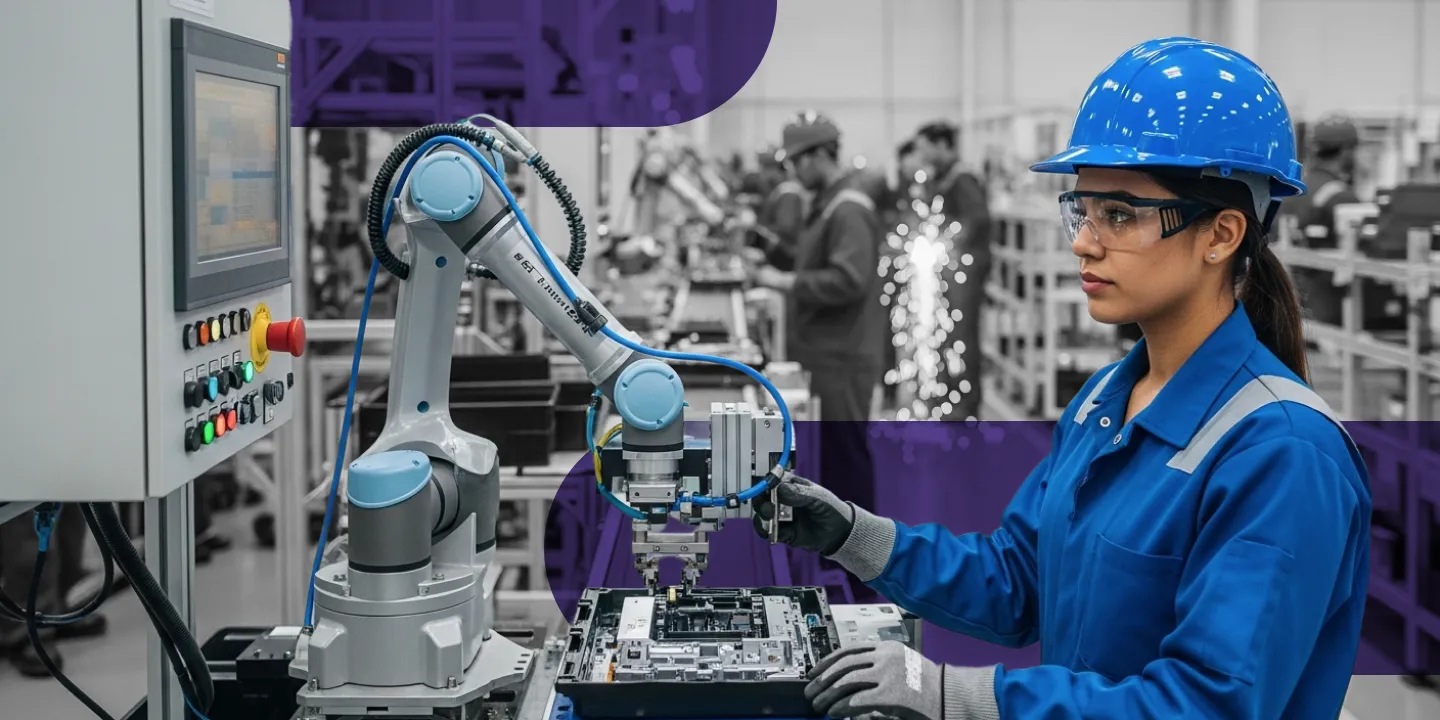
Manufacturing M&A workforce integration requires specialized approaches. Plant workforces operate within safety protocols, shift structures, and certification requirements that don’t exist in office environments. Getting this wrong stops production, not just projects.
Key Takeaways
- Safety certifications and operational compliance transfer with the workforce, not just the deal paperwork.
- Union consultation rights and works councils can reset integration timelines by weeks or months.
- Multi-shift payroll complexity is an operational risk that belongs on the executive agenda, not the HR backlog.
- Supervisory model misalignment is where manufacturing integration most often wobbles at the floor level.
- EOR solutions can stabilize plant employment during the integration window when entity decisions are still unresolved.
Most post-acquisition workforce playbooks are built for office environments. M&A workforce integration in the manufacturing sector requires a different approach entirely. Post-merger integration frameworks designed for white-collar businesses don’t account for shift structures, safety certifications, or site-level labor dynamics that don’t map neatly across borders or ownership changes.
The challenge is preserving production continuity while aligning employment structures, compliance controls, and operating authority across multiple countries. In a manufacturing acquisition, the workforce is not adjacent to the business. It is the business. A missed training record, an unclear reporting line, or a payroll error on a night shift can affect output, safety, and retention immediately.
For acquirers, the integration question is less about speed than sequence. Safety qualifications, labor consultation obligations, and shift pay structures need to be understood before the first harmonization discussion begins. Companies that treat plant integration like a white-collar onboarding exercise learn that lesson on the shop floor.
Why does manufacturing M&A workforce integration require a different playbook?
Manufacturing workforces operate inside tighter operational constraints than office-based teams. Standard integration playbooks assume a tolerance for ambiguity that plant environments simply don’t have.
Production schedules, maintenance windows, and supervisory coverage create little room for disruption. A plant cannot pause because an acquired workforce is still being mapped into new HR systems. Payroll must run accurately across shifts. Certifications must remain valid. Reporting lines must be clear enough that production accountability survives the ownership change.
Plant workforce integration after acquisition tends to expose weak planning faster than other workforce types because the issues are concrete. You cannot smooth over confusion about overtime eligibility, machine authorization, or line supervision with town halls and an updated org chart.
Manufacturing environments also carry more legacy variation. Two acquired plants doing similar work may use different job titles, training schedules, shift premiums, and safety protocols. Those differences are often rational in local context. They become a problem only when the parent company tries to standardize too early.
A global manufacturing acquisition is rarely one workforce. It is a portfolio of local labor systems tied together by a production strategy.
How does compliance transfer during a manufacturing acquisition?
Manufacturing workforce compliance includes an operational layer beyond contracts and HR records. Safety training histories, equipment certifications, and role-specific licenses transfer with the workforce and must be audited before close, not after.
The acquisition pulls across safety training histories, equipment certifications, hazardous materials handling qualifications, forklift and machine-operation permissions, and role-specific licenses. In most plants these records are maintained locally rather than in a centralized global system. That becomes a serious risk during integration. If documentation is incomplete or non-transferable, an employee may be legally employed but not operationally deployable.
Cross-border manufacturing workforce compliance adds another layer. Different countries treat training obligations, recertification periods, and employer responsibility differently. One jurisdiction may allow employer-recognized internal certification. Another may require an external or regulator-approved process. Even where two roles appear identical, the qualifications behind them may not be.
Do not treat certifications as an annex to workforce diligence. They should sit near the top of the integration workstream. A plant supervisor who cannot confirm which worker is cleared to operate what equipment is managing operational risk, not HR ambiguity.
How does labor law complexity affect multi-country manufacturing integration?
In multi-country manufacturing integration, legal compliance and operating design are tightly linked. You cannot redesign production staffing without simultaneously reviewing local labor rules.
Overtime rules are a clear example. In one country, overtime may be calculated weekly. In another, daily. Some jurisdictions impose strict rest periods between shifts. Others regulate maximum night work, Sunday work, or hazardous duty allowances differently. A parent company trying to align scheduling logic across multiple plants can easily create legal exposure by assuming one shift model can roll out across the whole footprint.
Hazardous working conditions complicate this further. Premium pay, protective equipment requirements, health surveillance obligations, and role restrictions may all differ by country and sometimes by region. These are not peripheral employment details. They shape how labor is deployed and what workforce models are even possible.
The more hazardous or regulated the environment, the tighter the connection between compliance and operations becomes.
How do union agreements and works councils affect manufacturing M&A timelines?
Union agreements and works councils can materially delay integration. In some jurisdictions, employers must consult worker representatives before changing schedules, reporting structures, or benefit terms. These timelines are legal obligations, not negotiating positions.
Works council compliance in global manufacturing M&A needs to be built into the deal plan early, not treated as a communications workstream after legal close. Consultation periods can delay plant-level restructuring, shift redesign, or policy rollouts by 30 to 90 days in EU jurisdictions and longer in some cases.
Unionized environments also require a careful reading of continuity obligations. Existing collective bargaining agreements may remain in force, transfer automatically, or constrain changes for a defined period after acquisition. Acquirers that assume they can rapidly harmonize terms across sites often discover that the labor architecture of the acquired business is more durable than the ownership structure.
Typical consultation timelines by region to factor into deal planning:
- European Union: Works council consultation typically takes 30 to 90 days depending on jurisdiction and decision scope.
- United Kingdom: Collective redundancy or TUPE consultation commonly takes 30 to 45 days minimum.
- Germany: Co-determination rights can extend negotiation phases significantly beyond initial estimates.
- France: Mandatory information and consultation with CSE is required before implementing structural changes.
The importance of integration in front-line supervision
Most integration teams focus on senior leadership first. In manufacturing, the more consequential layer is usually front-line supervision, where production accountability actually lives.
Plants vary widely in how authority is distributed. Some rely heavily on shift supervisors with broad discretion over staffing, training sign-off, and line adjustments. Others centralize those decisions with plant managers or engineering leads. When an acquired site is dropped into a new operating model without accounting for those differences, accountability becomes muddy fast.
Span of control matters here. A supervisor managing eight workers in one plant may be expected to manage 20 in another. That difference affects safety oversight, coaching, incident response, and production quality. A parent company that imposes its supervisory ratios without understanding local workflows may end up weakening control rather than strengthening it.
Production line accountability questions that must be clarified before integration completes:
- Who owns output targets at the line level after the ownership change?
- Who can halt a line, and under what authority?
- Who authorizes overtime or reassigns skilled workers across stations?
- How do safety incidents escalate under the new operating structure?
If these questions are not clarified early, acquired plants default to informal authority structures that conflict with the new company's expectations.
Why do job titles fail to transfer skill equivalence across global plants?
Job titles do not travel well in global manufacturing integration. A maintenance technician in one country may carry formal credentials signaling deep specialization. The same title elsewhere may reflect generalist responsibilities with entirely different safety exposure.
This makes global skills standardization difficult. Leaders want a consistent view of labor capability across the portfolio, but titles alone do not provide it. Legacy HRIS data often masks major variation beneath seemingly aligned roles.
The answer is to standardize capability frameworks, not titles. That means identifying the actual skills, certifications, equipment permissions, and decision rights required for core roles across the business, then mapping local roles against those standards. It is slower than relabeling jobs, but it creates a workforce model leadership can actually use.
Training integration becomes strategically important here. If job structures do not map cleanly, the organization needs a clear view of what upskilling, bridging certification, or local equivalency work is required to move people across sites or align production standards over time.
How should multi-shift payroll be handled after a manufacturing acquisition?
Multi-shift payroll alignment after acquisition is an operational risk, not an HR detail. Get pay wrong once and the workforce will conclude that ownership changed before competence arrived.
Shift premiums, overtime triggers, meal allowances, attendance bonuses, call-out pay, and holiday treatment often vary significantly between plants and countries. Even within one country, acquired entities may run different pay cycles or interpret local rules differently.
A rushed alignment effort creates two kinds of damage at once. First, it creates noncompliance when local pay rules are misunderstood. Second, it damages retention when employees see earnings become less predictable during integration.
The right sequencing for payroll alignment:
- Map how each site currently calculates pay, including all shift differentials, local allowances, and custom practices.
- Identify which elements are legally required versus operationally inherited from prior management.
- Determine what can be harmonized immediately, what needs staged transition, and what must remain locally distinct.
- Treat any harmonization as a communication event requiring advance notice and manager briefing at the plant level.
Payroll is part of workforce stability in manufacturing. Treating it as a back-office integration item is a category error.
What communication approach works for plant-level manufacturing integration?
Integration communication written for salaried employees and delivered to hourly workforces fails consistently. Plant employees need information that is direct, specific, and timed to real decisions. Strategic messaging about synergy doesn’t answer the questions they’re actually asking.
Workers need answers to concrete questions: Will shifts change? Do certifications remain valid? Who is the new reporting line? Are union terms still in place? When do payroll or benefits processes change? High-level messaging has limited value if it does not address those questions.
The medium matters as much as the message. Communication sent by email to employees who do not sit at desks misses the workforce that most needs clarity. Plant-level briefings, line manager toolkits, translated materials, and repeatable supervisor scripts are typically more effective than polished executive town halls.
In manufacturing, communication ambiguity has operational consequences. If workers do not know which procedures still apply or who can authorize overtime, confusion moves from rumor to downtime faster than most corporate integration teams expect.
How does EOR support stabilize manufacturing workforces during the integration window?
Employer of record solutions can provide compliant employment continuity for plant workers when entity decisions are still unresolved. This bridges the gap between acquisition close and operational stability without forcing rushed legal entity setup during post-merger integration.
Some acquisitions close before the long-term employment structure is settled. Entity decisions may still be under review. Payroll harmonization may not be ready. Local compliance requirements may outpace the acquirer's internal capacity. That creates a dangerous window between ownership change and operating stability.
EOR for manufacturing acquisitions is particularly valuable in cross-border deals where entity rationalization will take time or where a plant has been acquired in a jurisdiction new to the parent company. Instead of rushing entity setup or running avoidable compliance risk, the acquirer can preserve workforce continuity and production stability while longer-term decisions are finalized.
EOR support for manufacturing integration works best when:
- The acquiring company lacks an existing local legal entity in the country of the acquired plant.
- Entity consolidation decisions are expected to take 60 to 180 days after close.
- The integration is cross-border and payroll compliance complexity is high.
- Local labor law requirements are unfamiliar to the central HR or legal team.
This approach also reduces pressure on central teams. Rather than building local employment capability in parallel across multiple countries, leaders can use EOR support selectively where the integration window is most exposed.
What is the right framework for manufacturing M&A workforce integration?
The right frame for manufacturing workforce integration is continuity with control, not standardization speed. Operational disruption is expensive. Unmanaged local variation compounds across a global plant network. Both risks are real.
That means sequencing decisions carefully. Acquisition workforce planning should begin with stabilization: Employment, pay, certifications, and plant-level authority first. Handle representation obligations early and seriously. Build a skills framework before forcing job architecture alignment. Treat payroll and scheduling logic as operating infrastructure. Then standardize where standardization creates real value.
Companies that integrate manufacturing workforces well do not confuse uniformity with integration. A multi-country manufacturing business can run as one enterprise without making every plant identical. They also know that workforce decisions in a plant environment carry more immediate consequences than similar decisions in office-based settings.
The best manufacturing acquirers approach workforce integration with operational humility. They respect local labor systems, site realities, and the fact that manufacturing work is governed by more than contracts and org charts. That discipline is what turns an acquired plant portfolio into an integrated manufacturing business.
Frequently asked questions (FAQs)
More Resources




Talk to Sales
Book a demo today
We’d love to learn more about your needs and show you how we can help. Submit the form and we’ll be in touch to schedule a personalized demonstration of our platform and services.
Schedule an appointment
Fill out the form to speak to a rep about how we can help your organization.